
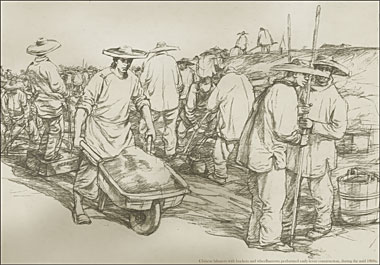
Chinese Laborers
Sacramento-San Joaquin levees were built in the mid to late 19th Century to prevent flooding on prime agricultural land. Most of the land was at sea level, and levees were frequently constructed on top of natural dirt barriers that formed along rivers and sloughs. Many of the levees were built by Chinese laborers using hand shovels and wheelbarrows.
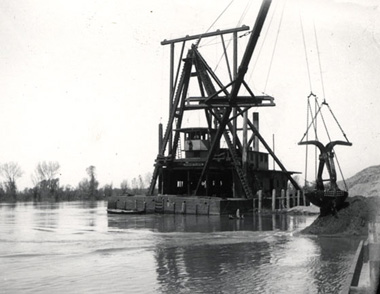
Sidedraft - Clamshell Dredge
By the turn of the 20th Century, the sidedraft-clamshell dredge was used to remove material from riverbeds to increase the size of levee barriers. These Delta levees are built on a foundation of sand, silt and peat which make them susceptible to erosion, seepage and breaks.
In 1917 Congress authorized the Sacramento Flood Control Project, which was completed by the U.S. Army Corps of Engineers in 1960. “Project levees” built by the Corps were designed to provide superior flood control protection. Once completed, the general upkeep was turned over to local entities. There are over 1600 miles of State-federal project levees in the Central Valley, 385 miles of which are located in the Delta.
Over 700 miles, or 65 percent, of Delta levees are classified as “non-project.” These flood control structures have been built and maintained by landowners or reclamation districts to protect agricultural lands. Frequently, they are not as stable as the project levees.
 Sacramento Riverfront Property Owners Association